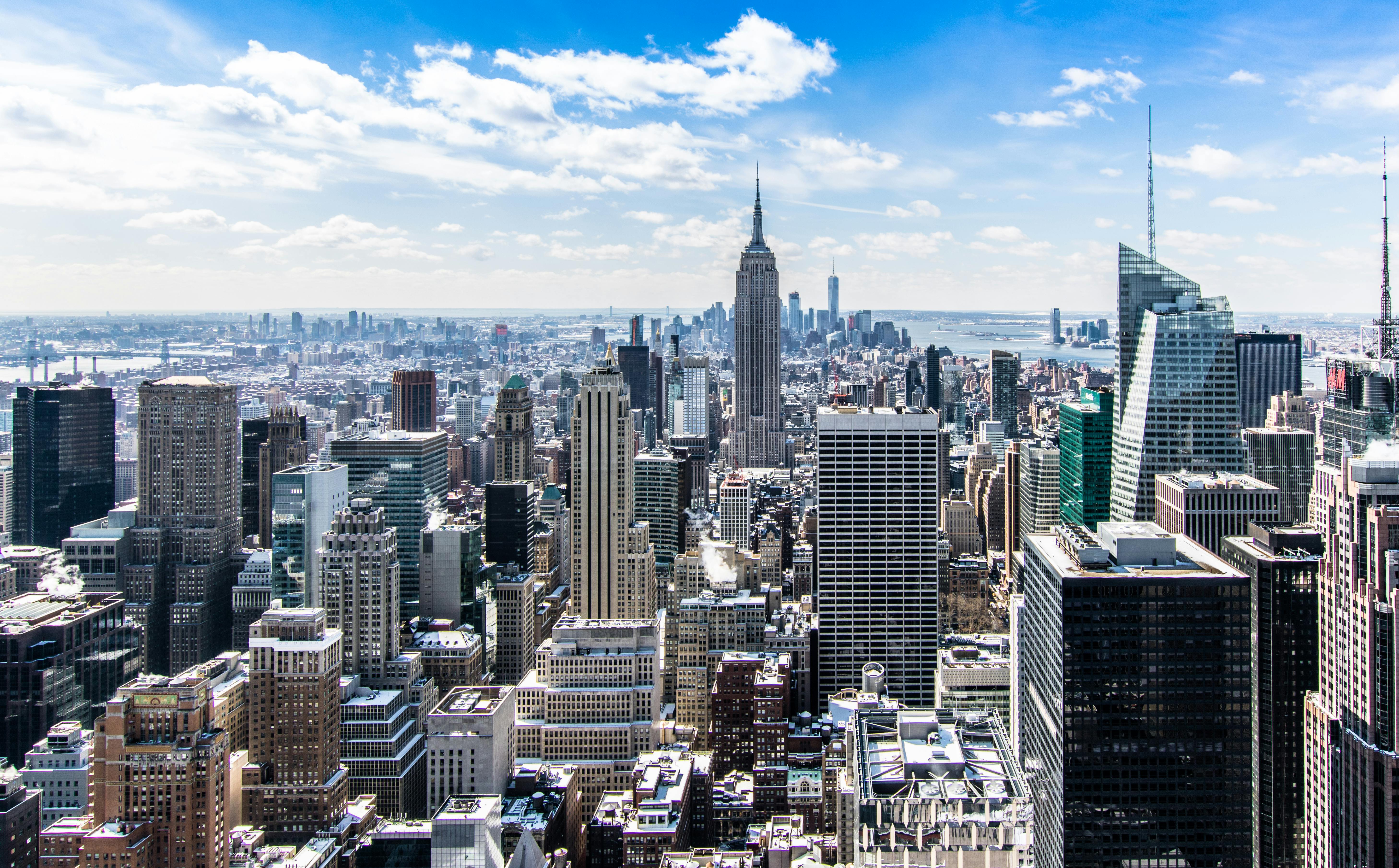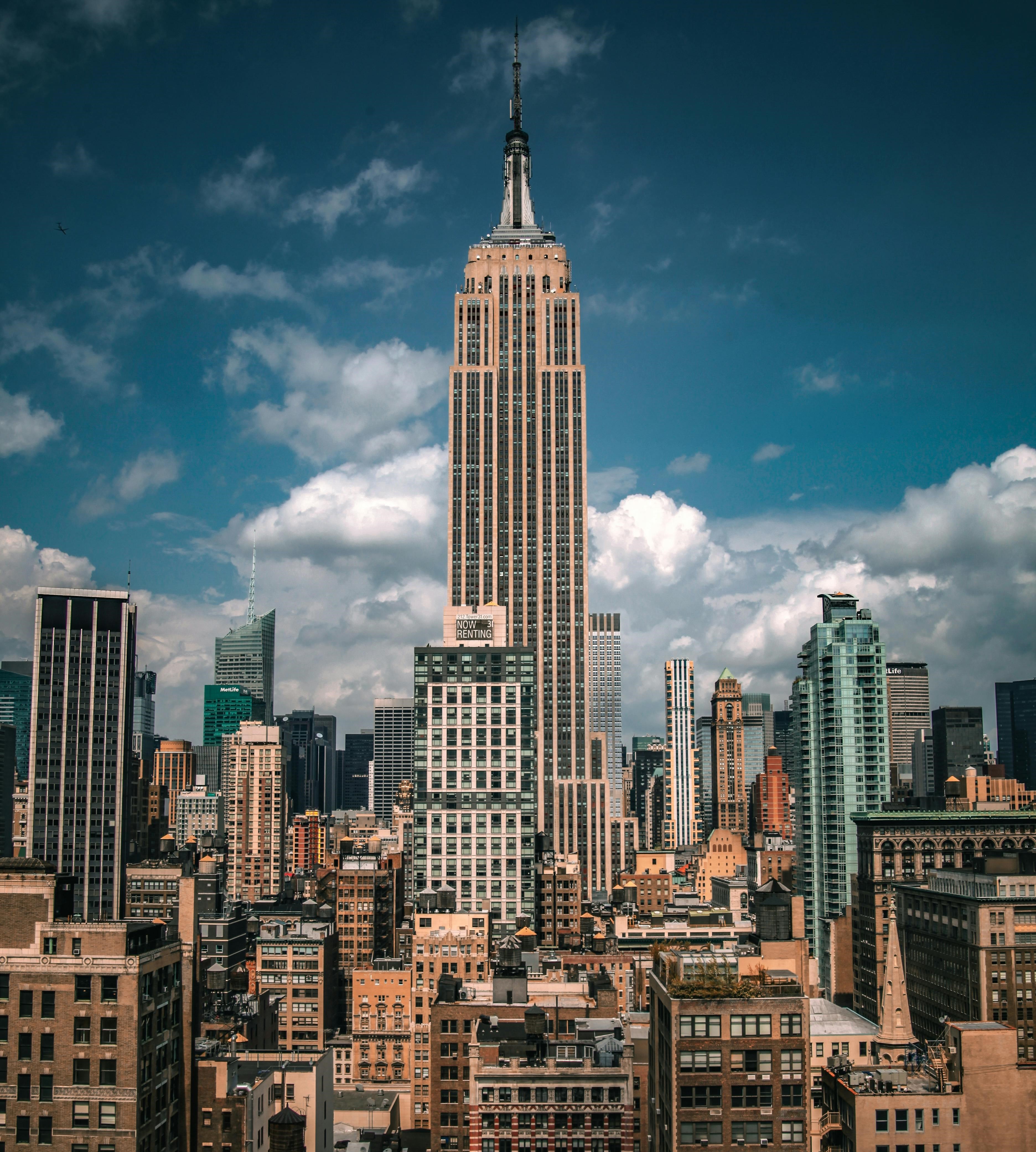
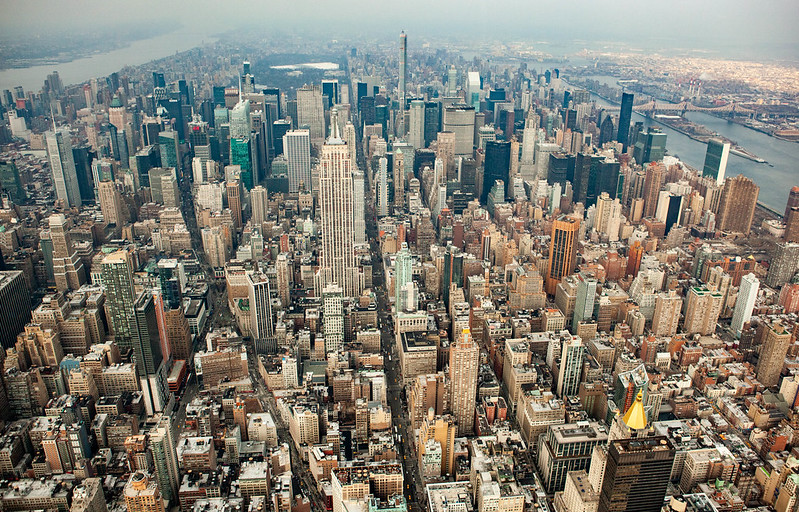
When you think of New York City, you probably picture its skyline, right? A string of massive skyscrapers, shepherding the bustling streets below. The Big Apple is known for its iconic buildings, and there are over a million of them in total. So it should come as no surprise that NYC’s buildings alone contribute 70% of the City’s total greenhouse gas emissions; though I’ll admit, I was taken aback the first time I heard this statistic. In other major cities like Los Angeles and Hong Kong, the building sector constitutes 43% and 60% of emissions, respectively, so New York City has a glaring opportunity to tackle climate change locally with aggressive action in this area.
The Mayor’s Office of Climate & Environmental Justice (MOCEJ) has been applying increasing pressure to its highest-emitting sector, and Local Law 97 could be its ace in the hole. Passed in 2019 as the centerpiece of the City’s Climate Mobilization Act, LL97 requires most large buildings in NYC (those over 25,000 square feet, so approximately 50,000 buildings) to reduce their carbon emissions 40% by 2030 and reach net-zero by 2050, making it one of the most ambitious building emissions regulations in the world. If you’ve been hearing more buzz about the Law lately, that’s because the City just wrapped up the first major milestone in LL97’s implementation– mandatory emissions reporting for compliance with 2024 limits– and the results were… mixed.
But Local Law 97 won’t be forgiving to those unwilling to clean up their act. The polluter pays principle is the backbone of the Law’s anatomy, with an annual fine of $268 per ton of CO2 equivalent emitted over the limit, with the cost for carbon increasing after 2030. This is the first time New York City has imposed a financial penalty on greenhouse gas emissions, and it’s already sending shockwaves through the local economy. Not to mention, NYC has garnered the attention of cities around the globe, eager to watch this market-based approach to climate action play out. Let’s get into its significance.
What Makes NYC Buildings Particularly Bad Polluters?
Like most cities, a significant proportion of NYC’s building stock relies on fossil fuels for heating, cooling, and electricity. Tack on poor insulation and inefficient windows in most of these buildings, and you have almost around-the-clock energy usage. The City’s largest buildings are intuitively where the bulk of the emissions from this sector originate, so the main climate antagonists are appropriately in LL97’s crosshairs.
Energy Use Intensity (EUI) for NYC Office Buildings

How Difficult Has LL97 Compliance Been So Far?
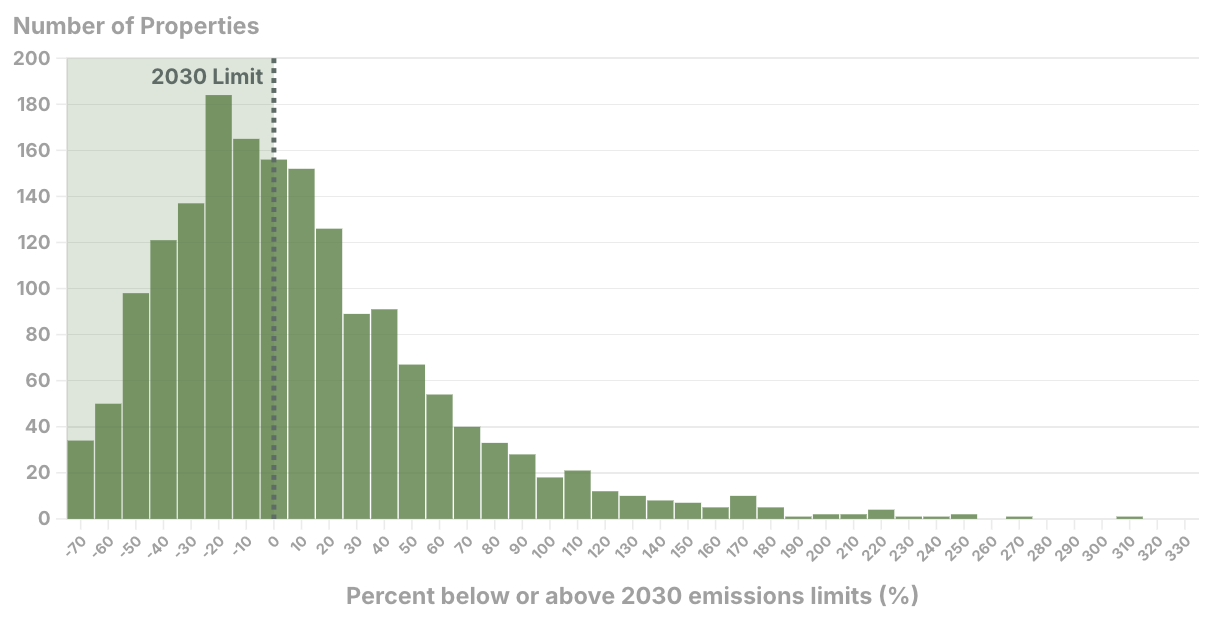
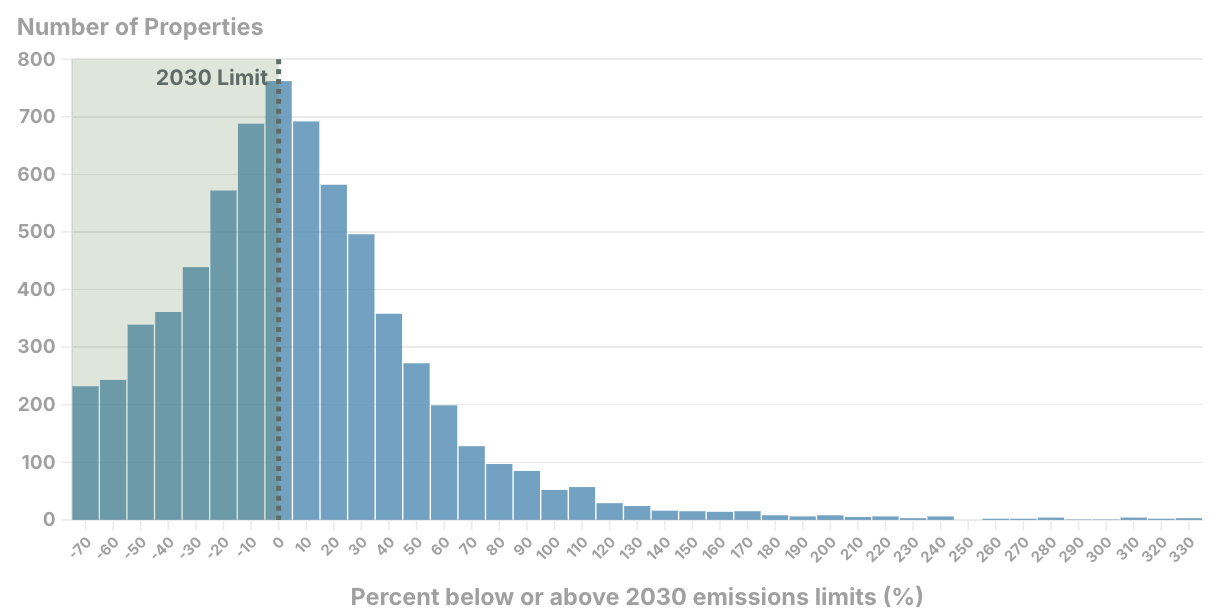
Well, here’s what we’re seeing from the first round of reporting: 92% of applicable buildings are already meeting their 2024 emissions limits. That’s the good news. The sobering part? 57% of buildings are currently above their 2030 caps, meaning most will need significant upgrades to their equipment and/or envelope in the coming years. That’s 28,500 of NYC’s largest buildings that have to clean up their act or pay the price.
NYC Properties Above the LL97 2030 Limits
Office Buildings
Multifamily Buildings
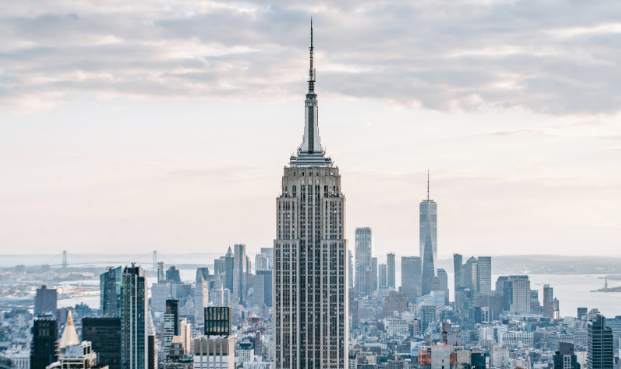
One notable building on the list of poor performers: The Empire State Building. This 102-story skyscraper has been a fixture in NYC’s skyline since 1931, and has undergone several retrofits to improve its energy efficiency over the past years. Though the building has plans to continue decarbonizing on pace with LL97 limits, the current emissions footprint of the structure exceeds the 2030 cap by 17%, translating to a penalty of $700,000 per year. Deep energy conservation, energy recovery, and electrification measures are slotted over the next 15 years to stave off this financial blow.
For those interested in exploring the energy breakdown and LL97 compliance (or lack thereof) for specific buildings and the City as a whole, the NYU Stern School of Business and Urban Green Council have partnered to create a Decarbonization Compass (see below) with the granularity to do so.

Based on the data at the time of the snapshot taken above, over $93 million is currently owed across the City for failure to comply with 2024 emissions standards, and nearly 5 times that will be on 2030’s price tag when emissions limits tighten and fines increase. That is unless swift action is taken to draw down these emissions.
So yes, LL97 is a big deal. And now that the first round of reporting is done, the real work (and opportunity) begins.
What’s the Recipe for Success?
As with most things, proactivity pays off. The Madison is one triumph to look to, demonstrating that compliance with LL97 is not as formidable as it seems. This 6-story, 42-unit co-op built in 1938 has already achieved compliance with LL97 through 2035 by partnering with NYC Accelerator, the Citywide program offering free, tailored technical assistance from its staff of energy experts. The service also provides support with capital planning and maximizing incentives, and even locates technicians offering the upgrades needed for compliance on a building-specific basis.
After implementing its bespoke energy transition and retrofit strategy, including the installation of 140 rooftop solar panels and an upgrade to efficient LED lighting, The Madison slashed its gas bill by 45% and reduced lighting costs by 25%, shrinking its emissions in the process. By taking action early, the building was able to capture several tax incentives that have eased the financial burden of these modernizations. Now The Madison can coast for the next 10 years, knowing that reporting will be a breeze each May, and that shareholders will continue to see the payoff of this foresight.

The future for the co-op could involve purchasing renewable energy certificates (RECs) or carbon offsets to further dip the building’s emissions when limits become more demanding.
How Will the Real Estate Market React to the Law?
For building owners, there will be a choice: pay for the upgrades or face the fines. There is a strong argument for biting the bullet and performing the retrofits– energy efficient buildings mean lower utility costs, and investment in more efficient HVAC systems or insulative windows and walls have a fairly short payback period. Owners who do make transitions will enjoy higher property value, and attract environmentally-minded tenants and corporations. Businesses that hold decarbonization policies and disclose their emissions will be inclined to occupy buildings that reflect their corporate sustainability goals, giving progressive building owners a leg up when it comes to securing large-scale commercial leases.
The opposite will be true for owners reluctant to retrofit; inefficient buildings will depreciate and become the unappealing option for new lessees and lenders. Undoubtedly, some owners who kick the ball down the road and absorb the fines for excess emissions will pass these costs onto their tenants. And in a city where rent is almost double the national median, this will not be welcome news. Renters will only tolerate so much increase before these owners will have to shape up– we can expect to see lease re-negotiations and terminations as buildings work to navigate compliance. And for the heavy emitters unable to keep up, they may be sold at a low cost, flipped and brought up to compliance, then get rebranded as high-end properties, creating unaffordability for existing tenants and surrounding neighborhoods.

In the future, it will likely become more difficult to secure a loan on a property whose energy efficiency is not up to par. As the scope 3 emissions of banks and financial institutions (which includes the emissions of their loanholders) become subject to increasing scrutiny by the Securities and Exchange Commission and states like California, the lenders behind most building mortgages will grow more selective about the buildings in their portfolio.
Only time will tell exactly how the aftermath of Local Law 97 will play out, but one thing’s for sure: it will not be sustainable to resist upgrades as the non-compliance fines ramp up in the coming years. The drawdown of emissions from NYC’s building sector is not a momentary trend, it’s becoming the new expectation across the regulatory landscape and real estate market alike.
How Will the Law Impact the Local Economy?
The effects of Local Law 97 will be felt far beyond the walls of large buildings and the wallets of those who own them. Firstly, the Law promises to be a catalyst for economic shift and growth. A City analysis estimates that LL97 could generate over 26,700 jobs by 2030. Specifically, the demand for contractors, engineers, and consultants specializing in energy-efficient retrofits and renewables is increasing, fueling growth in the green jobs sector.
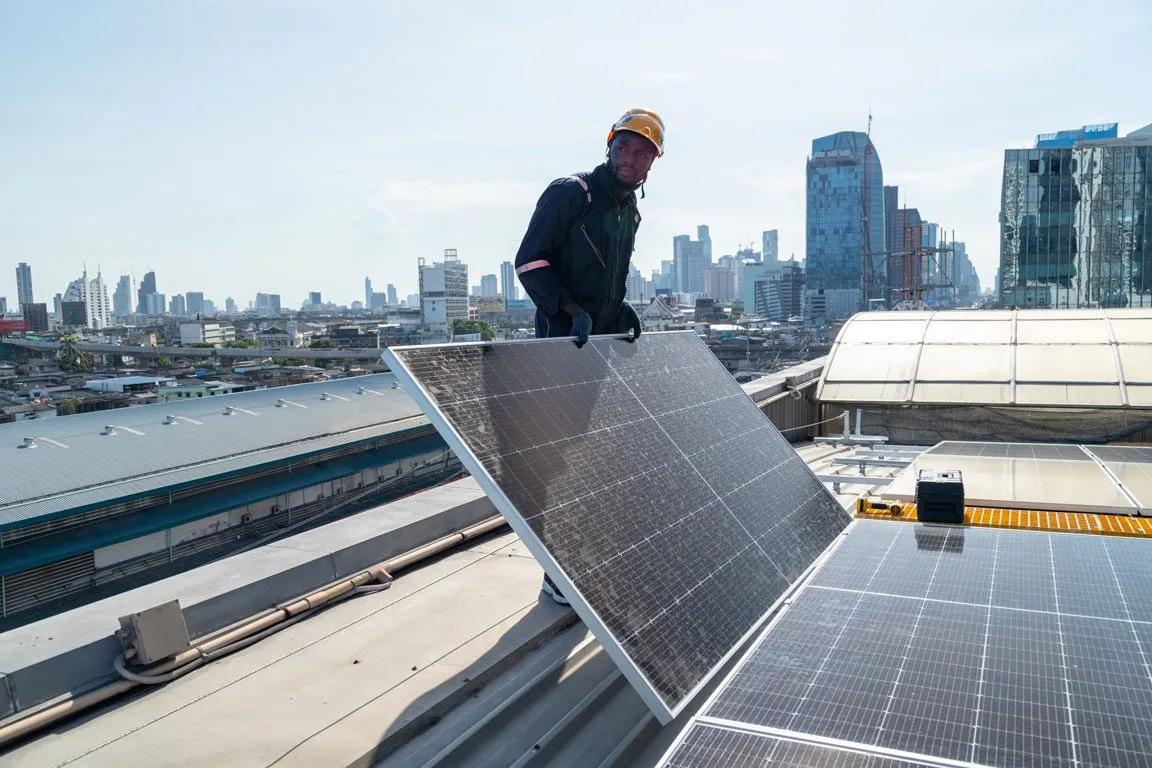
Plus, stricter building performance regulations are pushing real estate developers and architects to rethink design, energy, and materiality, sparking innovation and investment in climate-friendly building technologies. And with an increasing number of buildings transitioning to renewables, there is a powerful incentive for investors to pour capital into the sector, which will drive improvements in the efficiency of renewable technologies, expand energy storage capabilities, and encourage more effective grid management solutions.
Projected Public Health Outcomes
In another vein, there are health benefits on the table for New Yorkers if LL97 achieves its goals. Net zero emissions from the building sector by 2050 means that 6 million tons of CO₂e will be prevented from entering the atmosphere. Cleaner air and a cooler microclimate in the summer are things I think we can all get behind. Research indicates that 150 air quality-related hospitalizations and 50-130 heat-related deaths can be prevented each year, pending the success of the Law.

Thinking Bigger
Local Law 97 solidifies the accountability of the building sector for its greenhouse gas emissions and the adverse consequences they create. Where gaps currently exist in quantifying the operational emissions of buildings under green certification programs like LEED, LL97 bridges this chasm, and provides a replicable methodology for carbon accounting and reporting across the sector.
If NYC can show that aggressive building-performance standards actually work– that it’s possible to slash emissions, create thousands of jobs, and improve public health all while maintaining a strong real estate market, other cities will undoubtedly follow suit. Washington, D.C., Boston, and Seattle have already implemented similar regulations, and the momentum is building. The ripple effect of LL97 could offer a real chance to bend the global emissions curve– so don’t look away.